| Kommentarer |
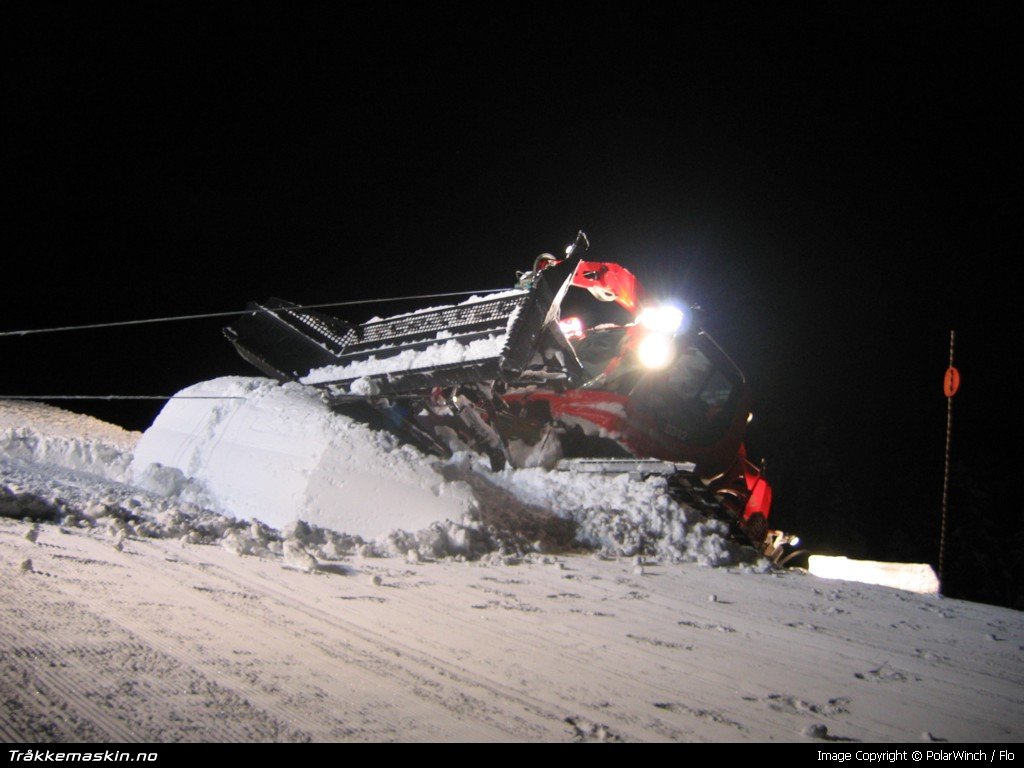
Why do you have a wire attached under the blade? | Kommentert av: Kim Pedersen
Dato: 05.02.2008 19.43.00 |
|
fordi de e ei pb som ikkje kjem se opp sjøl! | Kommentert av: Sjur Ringstad
Dato: 05.02.2008 19.54.20 |
|
That's the wire/rope out of the winch. Instead of using a permanent anchor at the top where the winchcat is hooked up I used a weel at the top and to return my hook back to the winchcat (bladeframe).
That's the way to double up the pulling power from 4ton up to a maximum of 8ton. You have to be realy careful when you operate the winch this way and you can only do backups, you can't turn around. | Kommentert av: Flo
Dato: 05.02.2008 23.27.59 |
|
LOL, goddamn nice solution Eder. haha. I loved that one.
(Hørrer du Bjønstad'n, hoho. Kasteblokk i 75'n, og du kunne dratt maskina opp på stive belter ;o) (nesten ihvertfall) | Kommentert av: Mathis Johannessen
Dato: 06.02.2008 00.59.50 |
|
Btw, Eder... Must be near impossible to operate the blade this way.. since your wire are attached under it.
hm... | Kommentert av: Mathis Johannessen
Dato: 06.02.2008 01.04.54 |
|
Ya, how the hell are you suppost to use the blade with out tearing up the cable and stressing out the push frame? | Kommentert av: Alexander Hyslop
Dato: 07.02.2008 03.17.49 |
|
You can use the blade nearly as usual without any problems. In the picture i use a big steel sling right around/behind the big eye in the middle of the bladeframe (its the center point and the stronges part of the bladeframe where most/all forces from the blade arise to the bladeframe). The steel sling has a diameter somewhat around 2.5 to 3 cm. You can also use a heavy chain (similar to those ones used on skidders in the forestry). | Kommentert av: Flo
Dato: 07.02.2008 03.34.47 |
|
Hm.. Okay. I think I would prefer using a havey chain under the blade, even though you under most conditions only would push the wire into the snow, rather than damaging it. Hit'ing a rock, would be painfull though. ;D Guess the bigest problem are the extra force/pressure this cause on the winsj-tower
Don't know what it's created to withstand, but... Then again, you said 'must be used with extreme caution'.
... and I guess you don't _HAVE_ to use all your 8 tonns of pulling-power either. Even though you could..
Nice solution anyways! | Kommentert av: Mathis Johannessen
Dato: 07.02.2008 18.05.11 |
|
I don´t think there will be a problem with an extra force on the winchtower.. The winch don´t pull more than 4 tonn, no more force than before.... But the force to the machine are: winch 4 tonn + pull to the blade 4 tonn = 8 tonn
Nice way to use the machine! | Kommentert av: Trond Bleka
Dato: 07.02.2008 18.28.03 |
|
that make sense!.... briliant when the mission is to only compact the fresh snow early in the season! :) (Dette hadde vært noe når du vinsja 75'n første gangen i år Bjørnstan.......) | Kommentert av: Ole Kristoffer Hole Olsen
Dato: 07.02.2008 18.34.41 |
|
But you are closer to the breaking strength of the wire... any problems with that? :) 11 kn or so? :) | Kommentert av: Ole Kristoffer Hole Olsen
Dato: 07.02.2008 18.35.51 |
|
And it is also a posibility to use the scale between 4 and 8 ton.... you dont have to use 8 ton all the time...... :) lets say 5,5 ton should be enogh for the most missions 2,75 tonn on the winch... :) facinating! :) | Kommentert av: Ole Kristoffer Hole Olsen
Dato: 07.02.2008 18.39.16 |
|
Im with Mathis , Thick chain extending past the blade would be better . Fatzer cables are not cheap and if it went good lord there would be some damage. | Kommentert av: Alexander Hyslop
Dato: 07.02.2008 20.53.29 |
|
The Everest we have has a hook welded in center of the blade, is that ment to be used like this?? see my pic: http://www.trakkemaskin.no/visBilde.asp?bid=8826 (It`s not a winchmacine, but still??) | Kommentert av: Trond Bleka
Dato: 07.02.2008 20.56.52 |
|
Another thing is, that you reduce your distance of reach by 50%. Since you use dobbel amount of wire.
But still, as i've said... really sweet solution.
Trond Bleka; So there is a sientific law, that say the force will always be evenly distributed? 50% winsj-tower, and 50% blade? | Kommentert av: Mathis Johannessen
Dato: 07.02.2008 21.58.12 |
|
The hook in the center of the blade, on your Everest.. are for towing-purposes. ( back to the workshop) (hø hø hø hø, funny funny) | Kommentert av: Mathis Johannessen
Dato: 07.02.2008 21.59.45 |
|
Yes, the force will be always be distributed 50/50% On te bladeframe and the tower. The force will also be distributed 50/50% on the two parts of wire, 4 ton on the part that goes to the tower, and 4 tons on the part to the blade. No problem with breaking strength of wire! And I am working with cranes when I'm not running the skilift, so I am quite sure about this one. | Kommentert av: Livar Gauksås
Dato: 07.02.2008 23.25.15 |
|
hehe good with skilled members :) | Kommentert av: Ole Kristoffer Hole Olsen
Dato: 07.02.2008 23.43.32 |
|
Ok, which law? I'm waiting.... | Kommentert av: Mathis Johannessen
Dato: 09.02.2008 16.54.59 |
|
Mathis, heard of a guy called Archimedes?
Archimedes was a great mathematician and engineer who was born in 287 BC in Syracuse, Sicily. He is credited with the development of many of our modern day mathematical and mechanical principles (such as Archimedes' principle, the concept of pi, and geometric proofs) and machines like the lever, a pump, and pulleys. According to Plutarch, Archimedes had stated in a letter to King Hieron that he could move any weight with pulleys; he boasted that given enough pulleys he could move the world! The king challenged him to move a large ship in his arsenal, a ship that would take many men and great labor to move to the sea. On the appointed day, the ship was loaded with many passengers and a full cargo, and all watched to see if Archimedes could do what he said. He sat a distance away from the ship, pulled on the cord in his hand by degrees, and drew the ship along "as smoothly and evenly as if she had been in the sea."
Archimedes understood the concept of mechanical advantage and how to use it to move or lift heavy objects with less force. The mechanical advantage of a machine is the ratio of the output and input forces that are used within the machine. A good mechanical advantage is a number that is greater than 1. The output force generated should be larger than the input force used to start the machine. For a simple machine like a pulley or a lever, these forces are easy to determine. For a pulley, the output force is the weight of the object and the input force is the force applied on the end of the rope.
A force is a push or a pull on an object or machine that may cause an action. Forces are measured in units of pounds-force (lbf) or newtons (N). A newton is a kilogram times a meter divided by seconds squared (N = kg m/s2). A force is a vector; it has both a magnitude (numerical value) and a direction. If an object is held up by a rope, for example, it has a force called the weight (the mass times the gravitational acceleration) acting downward, and it causes a tension in the rope, which acts upward. If the object is in equilibrium, the downwards weight of the object will be equal to the upwards tension. When something is in equilibrium, it means that it is not moving; all the forces are balanced. A book sitting on a table is in equilibrium. The weight of the book is balanced by the reaction force of the table on the book. The study of objects with forces in equilibrium is called Statics.
Archimedes knew that he could improve his mechanical advantage for lifting or moving an object by using pulleys. A pulley is an object that is usually round with a smooth groove around its outside edge. A pulley transfers a force along a rope without changing its magnitude. When engineers work with pulleys, they often assume that the rope through the groove of a pulley moves smoothly and evenly, without catching. They say it moves without friction. When two rough surfaces are rubbed together (like two wooden blocks), they become warm; the heat is caused by friction. If the two surfaces were slicked with oil and then rubbed together, they would move much more smoothly and very little heat would be generated. There is much less friction. Engineers also assume that the pulley and rope weigh very little compared to the weight on the end of the rope, so they can ignore these two weights and make their calculations with only the heavy weight on the end of the rope.
Want to see the rest of the text and some pics?
http://www.swe.org/iac/lp/pulley_03.html
| Kommentert av: Trond Bleka
Dato: 09.02.2008 21.12.15 |
|
Hm.. Husk at detta beskriver løft dah... i mitt hode ligner det mer på ett snordrag, det som foregår her.
... mulig jeg er skada men..... | Kommentert av: Mathis Johannessen
Dato: 11.02.2008 18.14.35 |
|
Nå har ikke jeg lest gjennom tidenes lengste bildekommentar, men kan ikke se at dette skulle bli ulikt på løfting/sleping? Lasten fordeles likt da også. Toppforankringen derimot vil ha 8 tonn belastning. | Kommentert av: Livar Gauksås
Dato: 11.02.2008 22.09.15 |
|
Det er nok ikke mange som gidder å lese så lange innlegg nei, poenget er at kraften som vaieren overfører ikke vil bli mer enn maks trekkraft på vinsjen og derav ikke større belastning på hverken vinsj eller vaier. Derimot er det riktig som Livar påpeker at forankringspunktet vil få dobbel belastning, i prinsippet er det heller ikke forskjell på om man bruker et slik taljesystem til løft eller slep. | Kommentert av: Trond Bleka
Dato: 11.02.2008 22.36.27 |
|
Verdiene om du regner ett snordrag på det, er garantert ikke 50/50. ( Wire'n sin bruddstyrke reduserves vel noe.. Avhening av diameter'n på hjulet den slåes rundt, også, uten at det er meningen å starte en ny 'diskusjon' :o) Fakkit, fysikk-guru wanted. Anyone? ;o) | Kommentert av: Mathis Johannessen
Dato: 12.02.2008 14.32.32 |
|